Cloud migration’s unfinished half
Foundry Flow automates application packaging and delivery, helping organisations remove one of the biggest barriers to cloud desktop adoption.
Most enterprises describing their cloud migrations as complete are describing the server side, while the end-user computing layer those workloads have to reach is still on-premises or stalled mid-transition. The October 2025 Windows 10 retirement, with ESU (Extended Security Updates) running for paying enterprise customers through to 2028, has surfaced the gap without forcing anyone to resolve it.
Windows 10’s retirement gave the gap a deadline, but the gap itself is older and broader than any single Microsoft lifecycle event. Cloud migration projects have treated the end-user computing layer as separable from server-side workloads for years, with budget, ownership, and delivery timelines split between the two halves, which is why the user side has stalled in ways that are rarely a technology decision.
Packaging is the extensibility layer nobody owns
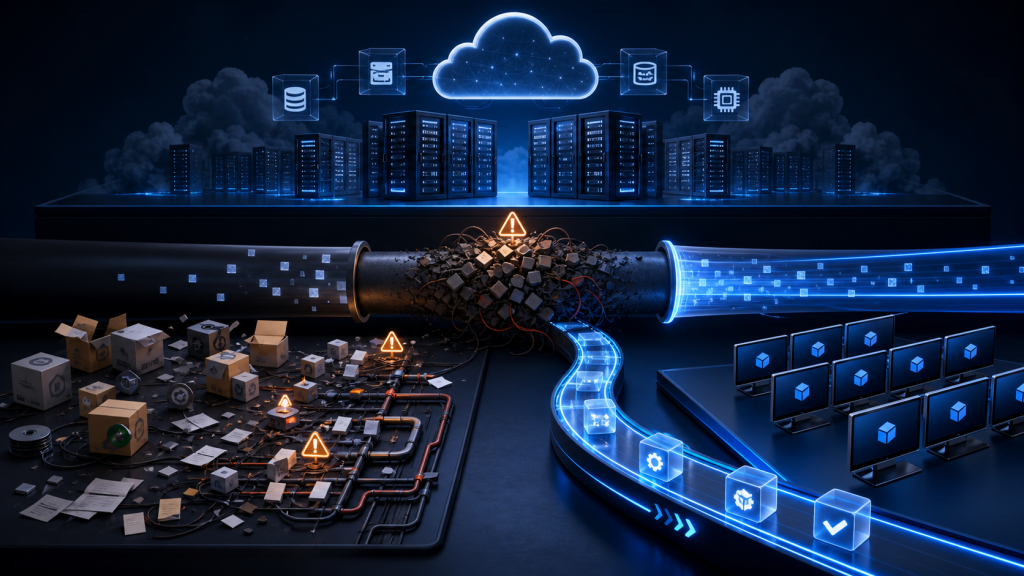
Every Windows application running on an enterprise desktop was packaged at some point using whatever tools were current at the time. Over the years, this has created a patchwork of MSI files, App-V sequences now in maintenance mode, and installer scripts written by employees who may no longer be with the organisation. When businesses move to a new delivery platform, this accumulated estate is what must be repackaged and modernised before applications can be deployed successfully.
Application packaging is where most cloud migration projects compress because the labour is real but distributed across IT teams in a way that never resolves into a single budget line. This is why it never makes the executive summary of the migration plan and is the first work to slip when the timeline narrows.
I argued in a recent blog that Project Online’s hidden dependencies are the structural reason Microsoft migrations slip, and that those dependencies are part of a broader pattern in which extensibility layers organisations have built operational dependencies around get treated as permanent infrastructure, with the lifecycle work left undone until something breaks. Application packaging is the same problem on a larger surface. It’s been the recommended way of delivering Windows applications since well before cloud was a viable destination, with dependencies on specific packaging tooling accumulating across enterprise estates for the better part of two decades.
The actual cost shows up most clearly when a rollout starts, with a pilot that successfully delivers ten or fifteen applications to a small group of users getting read as proof the migration is viable, even though what follows has to deliver several hundred applications to thousands of users on different hardware profiles and network configurations. The pilot works because the apps in scope are the ones whose packaging is already current. But the wider rollout slips on the apps that aren’t, with the timeline that the project plan assumed for packaging running against a deadline it was never designed for.
The platform decision is rarely the bottleneck
Application packaging needs an ownership model that treats it as continuous estate work, not a project task that gets stood up for each migration and dismantled afterwards. Whether the destination is Amazon Web Services WorkSpaces, Azure Virtual Desktop, Omnissa Horizon, or a modern Intune-managed Windows 11 fleet, once an organisation has visibility of which applications are being delivered to which users, through which mechanism, and with what dependencies, the platform decision is rarely the bottleneck; what does keep migrations stalled is the work to maintain that visibility continuously, and to repackage at scale when the destination changes.
If your cloud migration plan has the server side reported as complete and the desktop side still on-premises, the gap between the two halves widens with every renewal cycle that defers it. And Windows 10 ESU year one ends in October, with year two doubling the per-device cost.
Industrialising application packaging with Foundry Flow
This is the challenge Cloudhouse has designed Foundry Flow to solve. Foundry Flow automates application packaging and delivery for AWS WorkSpaces, removing one of the most time-consuming and operationally complex stages of cloud desktop adoption.
With one-click packaging and automatic publishing, applications are prepared and delivered without the manual effort that has traditionally delayed enterprise rollouts. Instead of treating packaging as a one-off project task, organisations can establish a repeatable and scalable process that keeps pace with infrastructure modernisation.
Until application packaging is automated, cloud migration remains only half complete. Foundry Flow removes this bottleneck with one-click packaging and automatic delivery for AWS WorkSpaces.
Discover how Foundry Flow can accelerate your cloud desktop migration here.