Guardian vs Tripwire Enterprise
Fortra
The established name in file integrity monitoring and security configuration management, with the category's largest policy library and deep reach into industrial and OT estates.
Where it is strong
- 4,000+ policy and platform combinations, maintained by a dedicated policy team.
- Long install base and strong brand recognition with auditors.
- Real-time FIM with ServiceNow and Splunk integrations.
Where Guardian differs
- Depth comes with operational weight. Fortra sells a separate ExpertOps managed service to run policy tuning and integrations for customers.
- Guardian is sold in three additive tiers, so you can evidence compliance with Essentials and switch on more later without re-implementing.
- Guardian's reconciliation covers ServiceNow, Freshservice, Ivanti Neurons and BMC Helix out of the box.
Choose Guardian if you want continuous drift detection and audit evidence across a hybrid estate without a services-led rollout.
Guardian vs Netwrix Change Tracker
Netwrix
A file integrity monitoring and hardening tool (formerly NNT Change Tracker) that separates planned from unplanned change through ITSM integration.
Where it is strong
- 250+ CIS-certified compliance reports.
- Wide OS, database and network device coverage.
- Closed-loop change control with ServiceNow, BMC Remedy, Cherwell and ManageEngine.
Where Guardian differs
- Guardian is built around an independent record of actual state across servers, end-user computing, network, cloud and containers, not only file integrity.
- A JSON-based comparison engine drifts almost any structure it is fed, and lets you compare nodes against a baseline or against each other.
- Built for outsourced estates: an independent record to check every supplier change against, whoever made it.
Choose Guardian if your drift problem spans more than files and registry keys, or your estate is run partly by suppliers.
Guardian vs Evolven
Evolven Software
A configuration risk intelligence platform that applies machine learning to configuration and change data, with a strong DevOps and CloudOps focus.
Where it is strong
- Patented AI risk scoring, anomaly detection and root-cause analysis.
- A CI/CD risk gateway that scores changes before they ship.
- Splunk and BMC partnerships.
Where Guardian differs
- Guardian leads on what an auditor will accept: embedded CIS Benchmarks, bespoke policy and continuous evidence for FCA, SOX, DORA, NIS2 and GDPR.
- Guardian covers network and end-user computing alongside servers and cloud.
- Guardian Enterprise adds AI change reconciliation and AI compliance, so you gain AI assistance without giving up the evidence trail.
Choose Guardian if compliance evidence is the deliverable and AI is there to speed it up, not to replace it.
Guardian vs CimTrak
Cimcor
A file integrity monitoring suite known for restoring changed files to a trusted state automatically, popular with US federal and CMMC buyers.
Where it is strong
- Restore mode can roll back unauthorised file changes on detection.
- A Trusted File Registry of known-good file hashes to cut false positives.
- CIS and DISA STIG baselines, with ServiceNow and Jira ticket validation.
Where Guardian differs
- Guardian does not auto-revert changes. In a regulated estate an unapproved automatic change is itself an audit event, so Guardian reconciles drift and routes the fix through your change process, or triggers automation in other systems through its API.
- Guardian provides evidence to support FCA, DORA and NIS2 reporting, as well as SOX and GDPR.
- Guardian's scope is configuration across the whole estate, including cloud and containers.
Choose Guardian if you need every change, including the fix, to be traceable to an approval.
Guardian and ServiceNow
ServiceNow
The system of record for IT services, assets and change. Guardian is not a replacement for it and most Guardian customers run both.
Where it is strong
- Active discovery populates the CMDB.
- The change module holds every request, approval and change window.
- Enterprise-wide workflow, reporting and ownership.
Where Guardian differs
- A CMDB records what is expected to be true. Guardian captures what is actually running and checks the two against each other.
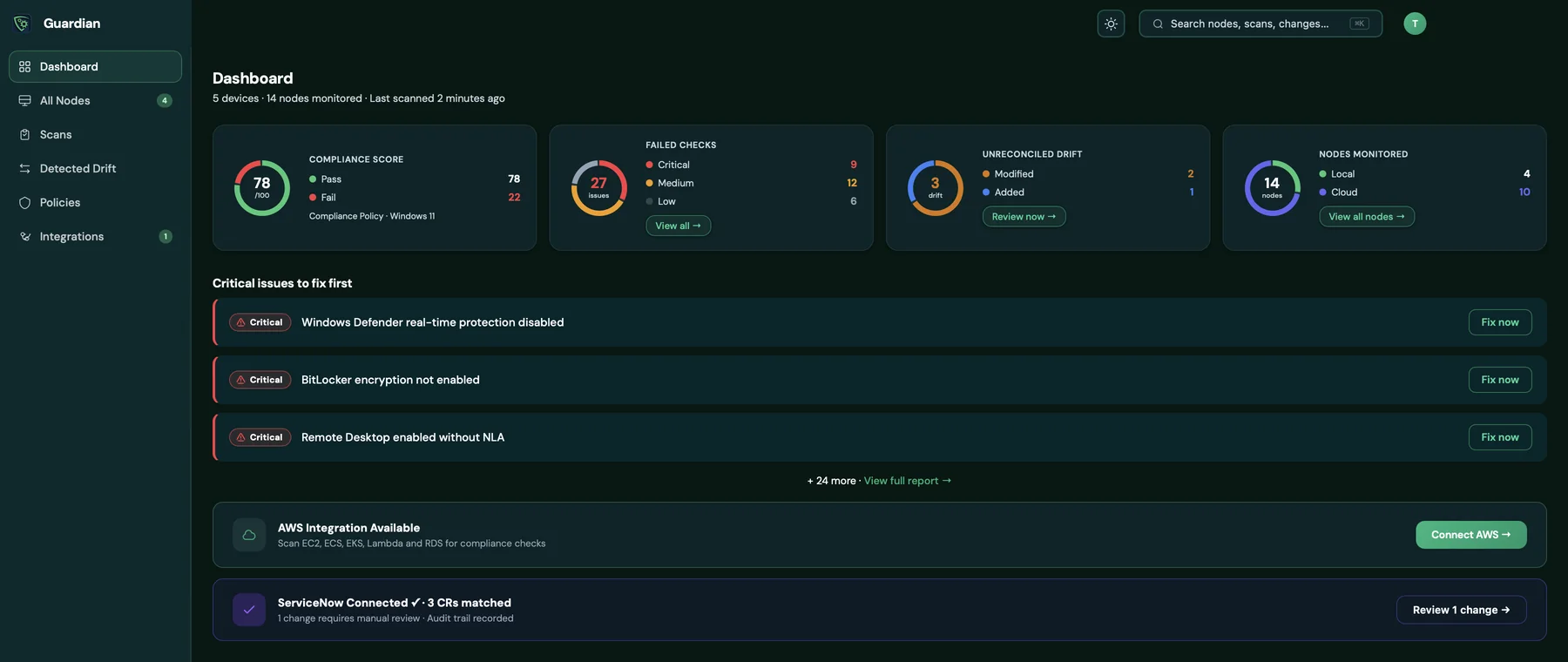
- Every detected change is matched to its change request. Changes with no approval are flagged the moment they appear.
- Guardian can raise incidents in ServiceNow, so the fix stays inside your existing process.
Choose Guardian if you need to prove that the CMDB, and the suppliers who update it, match reality.
A cloud security platform that scans cloud accounts without agents and ranks misconfigurations, vulnerabilities and identity risk by how an attacker could exploit them. Guardian works alongside it rather than replacing it.
Where it is strong
- Agentless scanning across AWS, Azure, Google Cloud, Oracle Cloud, Alibaba Cloud, VMware vSphere and Kubernetes.
- A security graph that ranks risk by attack path rather than as a flat list.
- Broad cloud security coverage: posture, vulnerabilities, identity, data and runtime.
Where Guardian differs
- Wiz asks whether a configuration is dangerous. Guardian asks what changed, on which node, and whether it was approved.
- Wiz sends its findings and inventory into ServiceNow. Guardian matches each detected change against its approved change request and flags the ones with none.
- Guardian covers the estate outside the cloud accounts too: physical servers, end-user computing and network devices, with evidence mapped to FCA, DORA and NIS2.
Choose Guardian if you need change control and audit evidence alongside Wiz's cloud security view.
Guardian vs IaC drift tools
Pulumi, Firefly, Spacelift, env0
Tools that compare live cloud resources with the infrastructure-as-code that defined them. The newer platforms, such as Pulumi Discovery & governance, also discover unmanaged cloud resources and use AI to write the fix as code.
Where it is strong
- Fast detection of drift between code and live cloud resources.
- Discovery of cloud resources created outside IaC, in the newer platforms.
- Policy as code, with AI-generated fixes proposed as pull requests.
Where Guardian differs
- They stay inside the cloud accounts. Guardian also covers on-premises servers, end-user computing and network devices, which have no IaC definition at all.
- The platform that deploys the infrastructure also audits it and, increasingly, has its own AI fix it. Guardian is an independent check on all three.
- Approval means code review. Guardian matches every change to an approved change request in your ITSM, and produces evidence for FCA, DORA and NIS2.
Choose Guardian if your estate is hybrid and your auditors care about all of it, not just the cloud accounts.
Observability and SIEM: a feed, not a rival. Dynatrace, Splunk and Datadog tell you something changed in behaviour. Guardian tells you which configuration changed, on which node, and whether it was approved. Through the REST API, Guardian's change evidence can feed your SIEM, so incident responders start from the answer to "what changed?"