What is configuration drift?
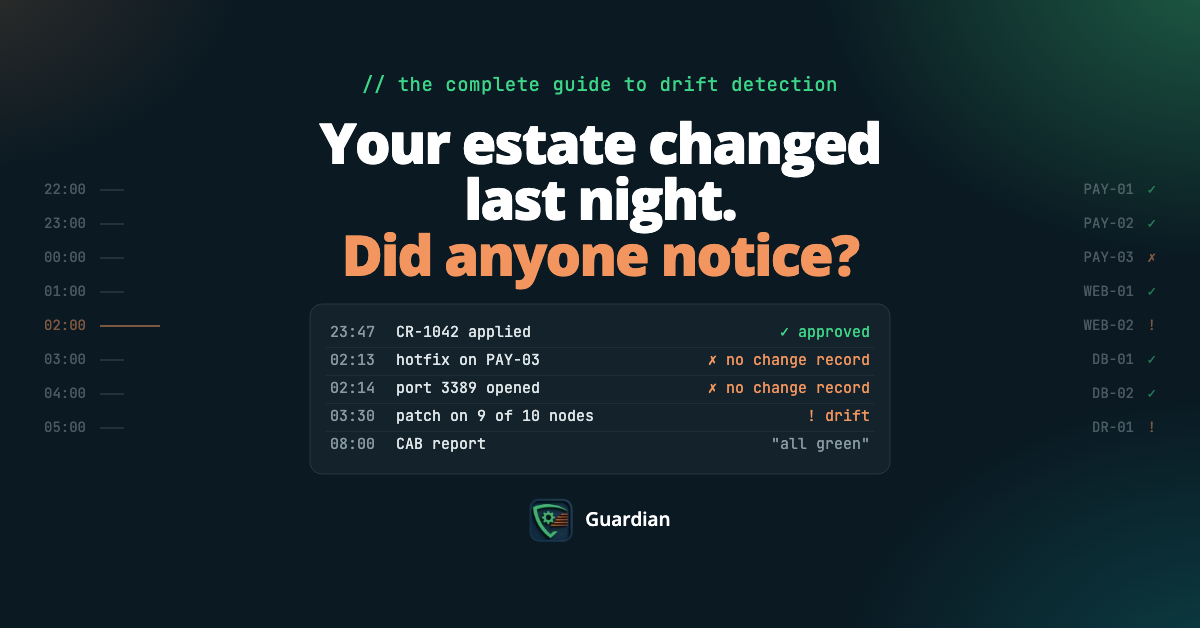
Configuration drift is the gap between a system’s approved configuration and the configuration actually running on it. It builds up when changes are made outside the approved change process, or when approved changes land differently from the plan.
Over time, servers that should be identical stop matching, security settings weaken, and the configuration management database (CMDB) no longer describes reality. In regulated organisations, drift also means you cannot prove that production matches what was approved.
Drift is usually silent. Each change looks harmless, and many are signed off individually. The problem surfaces later, as an outage, a failed audit or a security gap nobody knew was there.
Infrastructure drift, where cloud resources diverge from their infrastructure-as-code definitions, is one type of configuration drift. This guide covers the whole estate: servers, operating systems, applications, network devices, databases and cloud.
What causes configuration drift?
Configuration drift has seven common causes. Most involve no bad intent: every team follows its own process, the changes get signed off, and a year later servers that should match no longer do.
- Emergency fixes. A setting is changed during an incident to restore service, then never written back to the baseline or the change record.
- Manual changes outside the process. An administrator logs in directly, or edits a cloud resource in the console, to unblock a release.
- Uneven patching. Updates land on some servers and not others, or change default settings without anyone noticing.
- Automation that does something slightly different. Scripts, pipelines and increasingly AI agents make changes faster than people can review them, and not always exactly as approved.
- Approved changes that land differently. The change request says one thing; what is applied in production differs in a detail.
- Third parties and suppliers. Managed service providers and vendors make changes your team never sees.
- Many teams, one estate. After mergers, divestments or reorganisations, several teams change the same systems under different processes.
Why does configuration drift matter in regulated industries?
Drift creates three risks: outages, security gaps and compliance failures. In banking, insurance, healthcare and government, the third is often the one that gets noticed first, because regulators now ask firms to prove control over change, not just describe it.
The Uptime Institute’s Annual Outage Analysis 2026 found that major network-related outages are driven primarily by configuration and change management failures, named by 41% of respondents who had one. And 87% of respondents who suffered an impactful outage say it could have been avoided with better management, processes or configuration.
| Framework | Applies to | What it expects | How drift breaks it |
|---|
| DORA | EU financial entities, since 17 January 2025 | Documented ICT change management, segregation of duties, review of emergency changes | Changes made outside the process leave no approval or review on record |
| NIS2 | Essential and important entities in the EU | Risk-management measures covering secure configuration and maintenance of systems | Hardened settings weaken over time without anyone knowing |
| SOX | US-listed companies | IT general controls over change to financially significant systems | An unapproved change to an in-scope system is a control deficiency |
| PCI DSS v4.0 | Organisations that handle card data | Secure configuration standards, controlled change, change detection on critical files | Systems in scope drift from their configuration standard |
| ISO 27001:2022 | Certified organisations | Configuration management (Annex A 8.9) and change management (Annex A 8.32) | The documented configuration no longer matches the running one |
| FCA and PRA operational resilience | UK banks, insurers and investment firms | Important business services kept within impact tolerances | Drift is a common route to the change-related incidents these rules target |
Across all of them the auditor’s question is the same: what changed, and was it approved?
What are some examples of configuration drift?
These examples show how ordinary changes turn into drift across a typical enterprise estate.
| Example | How it happened | Risk |
|---|
| Windows servers in one cluster run different TLS settings | A patch landed on some nodes and not others | Weaker encryption on part of the service; failures on failover |
| A firewall port opened during an incident is still open | Emergency fix, never reversed | Exposure to attack; PCI DSS scope grows |
| A local admin account created to fix an issue is still active | Manual change outside the process | Security gap and an audit finding |
| Audit logging is switched off on a database server | Disabled while troubleshooting, never re-enabled | You cannot evidence activity on an in-scope system |
| The CMDB lists one application version; the server runs another | An upgrade went ahead without updating records | Wrong impact analysis at CAB; slower incident triage |
| A cloud storage bucket is publicly readable | Edited in the console during a hotfix | Data exposure |
| Two payment servers that should be identical have different registry settings | Different teams changed them after a merger | Inconsistent behaviour; disaster recovery fails |
How do you detect configuration drift?
There are six ways to detect configuration drift. Mature teams combine baseline comparison with change reconciliation, so every difference is either explained by an approved change or flagged as drift.
| Method | How it works | Best for | Limit |
|---|
| Baseline comparison | Compares each system’s live configuration with an approved baseline, such as a CIS Benchmark or a gold build | Servers and operating system hardening | Needs an agreed baseline first |
| Change reconciliation | Matches each detected change with the change records in your ITSM platform | Proving approval; audit evidence | Needs an ITSM integration |
| File integrity monitoring | Alerts when critical files or registry keys change | Critical files; PCI DSS change detection | Noisy; does not say whether a change was approved |
| Infrastructure-as-code checks | Compares deployed resources with what the code defines | Cloud resources managed in code | Blind to anything not in code |
| Cloud configuration rules | Evaluates cloud resource settings against rules | AWS and Azure accounts | Does not cover on-premises systems |
| Manual audits and scripts | Periodic checks and spreadsheets | Very small estates | Slow, and only a point in time |
Set how often you check by risk: the most critical and most regulated systems should be scanned most often. If you are replacing a file integrity monitoring tool, see our comparison of the best Tripwire alternatives.
How do you prevent and fix configuration drift?
You cannot stop every change, so the goal is to make every change visible and accounted for. These eight steps work for most enterprise estates.
- Define approved baselines. Start from CIS Benchmarks for each system type, adjust them to your policy, and record any exceptions.
- Know what you have. Build an inventory of every configuration item (CI), and check the CMDB against what is actually running.
- Send every change through one process. Include emergency changes, with a fast path and a review afterwards.
- Scan regularly against the baseline. Most often for the most critical and most regulated systems.
- Reconcile changes with approvals. Any change without a matching approved record is drift.
- Decide on each finding. Either revert it, or approve it and update the baseline. Be careful with automatic rollback: it can break services, and in a regulated estate a revert is itself a change that needs a record.
- Keep the evidence. Retain a timestamped history of changes and reports you can hand to auditors.
- Codify where you can. Infrastructure as code and policy as code reduce drift in the systems they manage, but they do not remove the need to check.
How does Cloudhouse Guardian handle configuration drift?
Cloudhouse Guardian is a configuration drift detection product built for regulated enterprise IT. It answers the question auditors, regulators and incident reviews ask: what changed, and was it approved?
- Approved baselines out of the box. Guardian measures each CI against more than 500 CIS Benchmarks, assigned automatically by system type.
- File-level drift detection. It shows which machine, which file and exactly what changed, with a timestamped change history for each system.
- Checked against approvals. Guardian checks detected changes against approved change windows in ServiceNow and Freshservice, so changes made outside an approved window stand out.
- Starts from data you already hold. Guardian Essentials onboards CIs from your ServiceNow CMDB and AWS accounts, with scan intervals you set.
- Audit-ready evidence. Reports export for auditors without screenshots or spreadsheets.
Guardian works alongside your ITSM platform, EDR and SIEM rather than replacing them, and is available on the ServiceNow Store.
Key terms
| Term | Definition |
|---|
| Configuration drift | The gap between a system’s approved configuration and the configuration actually running on it |
| Configuration baseline | The approved, documented configuration a system should match |
| Configuration item (CI) | Any component managed as part of IT service delivery, such as a server, application, database or network device |
| Configuration management database (CMDB) | The system of record for CIs and how they relate, often part of an ITSM platform such as ServiceNow |
| Infrastructure drift | Drift between cloud resources and their infrastructure-as-code definitions; one type of configuration drift |
| Desired state | The configuration a management tool tries to enforce on a system |
| CIS Benchmarks | Consensus-based secure configuration guidelines published by the Center for Internet Security |
| Change reconciliation | Matching each detected change to an approved change record, to separate approved change from drift |
| Unapproved change | A change made to production without an approved change record |
| Emergency change | A change made urgently to restore or protect service, usually reviewed and approved after the fact |
| Change advisory board (CAB) | The group that reviews and approves significant changes before they are made |
| File integrity monitoring (FIM) | Monitoring that alerts when critical files or registry keys change |
Frequently asked questions
What is configuration drift in simple terms?
Configuration drift is when a system no longer matches the setup it was approved with. Small changes build up over time until what is running differs from what is documented.
What is the difference between configuration drift and infrastructure drift?
Infrastructure drift is one type of configuration drift. It describes cloud resources that no longer match their infrastructure-as-code definitions. Configuration drift also covers servers, operating systems, applications, databases and network devices.
Is configuration drift the same as an unauthorised change?
No. An unauthorised change is one cause of drift. Drift is the cumulative result, and it can also come from approved changes that were applied differently from the plan.
Is configuration drift a security risk?
Yes. Drift can reopen ports, leave temporary admin accounts active, disable logging or weaken encryption, often without anyone noticing.
How does configuration drift affect compliance?
Frameworks such as DORA, NIS2, SOX, PCI DSS and ISO 27001 expect controlled change and secure configuration. Drift means production no longer matches what was approved, and that becomes an audit finding.
How often should you check for configuration drift?
By risk. Check the most critical and most regulated systems most often, and every system at least as often as your audit and change cycles require.
Can infrastructure as code prevent configuration drift?
It reduces drift in the resources it manages. Manual changes, emergency fixes and systems outside the code still drift, so detection is still needed.
What tools detect configuration drift?
File integrity monitoring tools, infrastructure-as-code checks, cloud configuration rules and dedicated drift detection products. Cloudhouse Guardian combines baseline comparison against CIS Benchmarks with checks against approved changes in ServiceNow and Freshservice.
See the drift in your own estate
Start a Guardian Essentials trial, connect one environment, and see which changes had approval and which did not.